
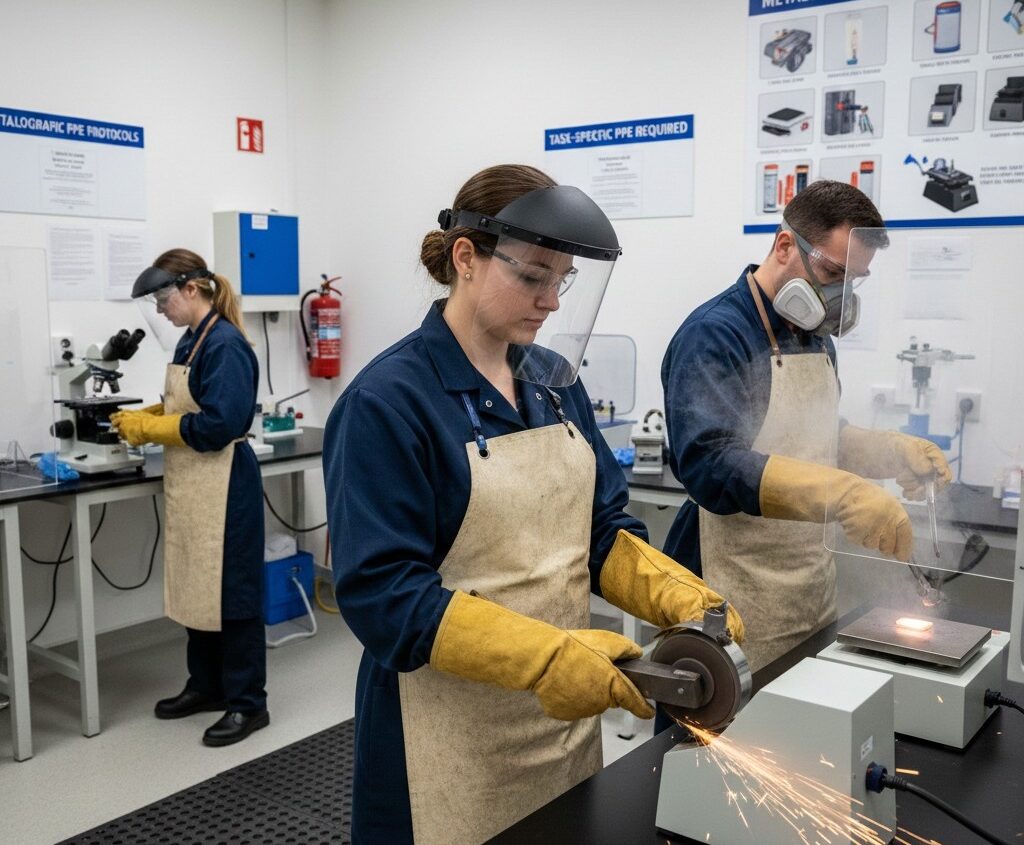
Safety & PPE in Metallography Labs
Metallography lab safety is more than regulatory compliance—it directly affects both operator well-being and the integrity of prepared samples. From our experience working with production labs, research facilities, and training environments, most safety incidents occur not because rules are missing, but because generic lab guidance doesn’t reflect real metallographic workflows.
Grinding heat, manual sample handling, and inconsistent PPE decisions are common contributors to injuries and damaged samples. Effective metallography lab safety requires task-specific protocols that align with how work is actually performed.
Why Metallography Lab Safety Requires Protocols
Generic lab safety policies create a baseline, but metallography introduces risks that vary significantly by process. Sectioning, grinding, polishing, and etching all behave differently in terms of heat, force, and exposure.
Common Metallography Lab Hazards That Go Unaddressed
- Heat buildup during dry or high-speed grinding
- Burn risk from handling small or thin samples
- Reduced control when gloves are poorly matched to the task
- Slippage or loss of grip on irregular specimens
These hazards are often underestimated because they develop gradually during routine work.
How Safety Failures Impact Both People and Results
When operators are burned or rushed, preparation quality suffers. Overheated samples can experience microstructural changes, edge rounding, or smearing, while poor handling increases rework and inconsistency. Metallography sample preparation safety directly influences result reliability.
Read: Metallographic Sample Prep: Practices for Precision Results
Metallography PPE Beyond Generic Lab Equipment
Metallography PPE must support precision work while protecting against heat, abrasion, and chemical exposure.
Why One-Size-Fits-All PPE Fails
Applying the same PPE across all preparation steps often introduces new risks. Grinding requires dexterity and heat awareness, while cutting demands impact and debris protection. Treating these tasks identically reduces both safety and control.
Task-Based PPE Categories in Metallography Labs
- Sectioning: face protection, cut-resistant handling tools
- Grinding & polishing: heat-aware hand protection, fixtures
- Chemical handling: splash protection, chemical-resistant gloves
Effective metallography PPE adapts to task-specific risk.
Grinding Safety in Metallography Labs
Grinding safety in metallography is where most injuries occur, largely due to heat and friction.
Heat, Friction, and Burn Risks During Sample Grinding
Dry grinding generates heat rapidly, especially with small samples. Operators often underestimate how quickly temperatures rise and overestimate the protection offered by common gloves.
Safety Risks of Dry Grinding in Metallography Labs
- Accelerated burn risk
- Reduced grip as gloves degrade
- Thermal damage to microstructure
- Operator fatigue and loss of control
These risks make metallography grinding safety both a safety and quality concern.
Best Gloves for Metallography Grinding
Glove selection is one of the most debated aspects of metallography lab safety.
Leather Gloves vs No Gloves at Grinders
- Gloves may reduce tactile feedback and increase snag risk
- Bare-hand grinding increases heat exposure
- The safest choice depends on sample size, duration, and control
There is no universal rule—only context-driven decisions.
Why Common Rubber-Dipped Gloves Fail Against Heat
- Minimal thermal resistance
- Rapid degradation during grinding
- False sense of protection
These gloves are involved in many burn incidents despite being widely used.
Heat-Resistant and Alternative Handling Solutions
- Sample holders and fixtures to eliminate hand contact
- Tongs for short-duration handling
- Heat-resistant gloves for specific high-temperature tasks
Reducing direct contact is often safer than relying on gloves alone.
Cooling Methods for Safe and Repeatable Metallography Grinding
Cooling is essential for both safety and result consistency.
Why Cooling Is a Safety and Quality Requirement
Cooling prevents burns, limits thermal damage, and improves repeatability between operators. It should be considered part of metallography lab safety protocols—not an optional step.
Practical Cooling Methods Used in Real Labs
- Intermittent grinding with cooling pauses
- Manual coolant application
- Integrated wet grinding systems
The method may vary, but some form of cooling should always be planned.
How to Safely Handle Small or Irregular Metallography Samples
Small samples present disproportionate risk due to rapid heating and reduced control.
Why Small Samples Create Disproportionate Risk
- Low mass increases heat buildup
- Limited grip increases slip risk
- Greater hand proximity to abrasives
Safe Handling Protocols That Reduce Injury and Damage
- Decide early whether mounting is required
- Use fixtures instead of free-hand grinding
- Stop and reconfigure when control is compromised
Knowing how to safely handle small metallography samples prevents both injury and sample loss.
Metallography Lab Safety Standards—And Where They Fall Short
Safety standards provide structure but often lack task-level guidance.
What Standards Cover—and What They Don’t
- Broad safety language
- Limited grinding and heat-specific detail
- Minimal direction on glove trade-offs
Why Labs Need Protocols Beyond Written Standards
Internal protocols translate standards into real-world actions that match equipment, materials, and workflows.
A Decision-Support Framework for Metallography PPE Selection
Good safety decisions are based on context, not habit.
Matching PPE to Task, Risk, and Sample Type
- Cutting vs grinding vs polishing
- Mounted vs unmounted samples
- Duration and heat exposure
Balancing Operator Safety and Sample Preservation
Overprotection reduces control; underprotection increases injury. The goal is informed balance.
Training Labs and Educational Environments: Teaching Safety the Right Way
Students face higher risk due to inexperience.
Why Students Are at Higher Risk in Metallography Labs
- Underestimating heat buildup
- Misusing gloves and fixtures
- Hesitating to stop unsafe setups
Building Safety Protocols into Training
Teaching why decisions are made—not just rules—builds safer long-term habits.
Daily Metallography Lab Safety Checklists and Best Practices
- Confirm sample size, handling method, and cooling before grinding
- Verify PPE and cooling during preparation
- Inspect samples for heat damage and document near-misses
Simple workflows reduce variability and accidents.
Safer Labs Produce Better Metallography
Effective metallography lab safety improves consistency, protects operators, and preserves sample integrity. Task-specific PPE, cooling, and handling protocols create better results—not just safer labs.
Metallography Lab Safety Protocols
At Metsuco, we help labs evaluate real workflows and develop practical safety protocols that protect people and samples alike. If you’re refining your metallography lab safety practices, we’re happy to explore what works best for your environment.
Add comment