
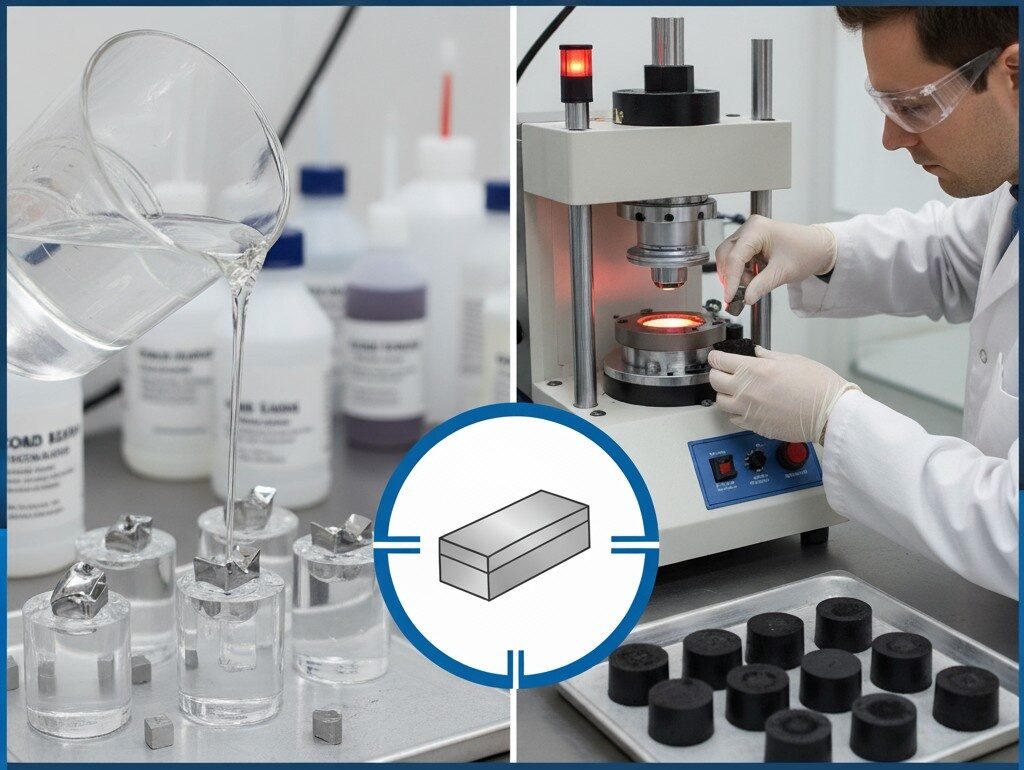
Cold Mounting vs Compression Mounting: Choose the Right Method for Your Samples
Why Mounting Matters in Metallography
In metallographic sample preparation, mounting plays a crucial role in protecting and supporting specimens during grinding, polishing, and microscopic examination. A properly mounted sample ensures smooth handling, precise edge retention, and reliable analysis results.
However, one of the most common challenges in labs is deciding between cold mounting and compression mounting. Each method offers unique advantages depending on the material type, heat sensitivity, and required turnaround time.
At Metsuco, we help laboratories across the USA achieve accurate, consistent results by offering reliable mounting materials and equipment suited for both methods.
The Role of Mounting in Metallography: Foundation for Accurate Results
Mounting is more than just an initial step—it directly affects the quality of metallographic analysis. When done correctly, it provides mechanical stability, protects fragile edges, and prevents contamination.
Proper mounting techniques in metallography ensure uniform sample surfaces for efficient grinding and polishing, while maintaining structural integrity throughout the process. This consistency is essential for dependable metallographic sample preparation and repeatable lab results.
Understanding the Two Main Techniques: Cold Mounting vs Compression Mounting
Cold and compression mounting represent two distinct approaches to sample preparation.
| Feature | Cold Mounting | Compression Mounting |
| Temperature | Low (room temp or mild heat) | High (under pressure and heat) |
| Curing Time | 5–60 minutes | 5–10 minutes |
| Sample Compatibility | Heat-sensitive or irregular samples | Hard, heat-resistant materials |
| Equipment | Simple molds and resins | Hot mounting press |
| Finish | Transparent, customizable | Durable, opaque, uniform finish |
While cold mounting is often seen as slower, modern cold mounting resins cure quickly and deliver excellent clarity. Compression mounting remains the go-to for fast, high-volume workflows where durability and precision are critical.
When to Choose Cold Mounting: Ideal for Heat-Sensitive and Irregular Samples
Cold mounting uses liquid resins such as epoxy or acrylic to encapsulate specimens without high heat or pressure.
Benefits include:
- Low-heat curing ideal for temperature-sensitive materials
- Minimal shrinkage for dimensional stability
- Clear mounts for optical or inspection purposes
It’s the preferred choice for samples like electronics, composites, and soft metals. Epoxy provides strong adhesion and clarity, while acrylic offers faster curing times.
Tip: To prevent air bubbles, pour resin slowly and use vacuum impregnation for complete coverage.
When to Choose Compression Mounting: Fast, Durable, and Consistent
Compression mounting—or hot mounting—relies on heat and pressure to create a strong, solid mount around the specimen using thermosetting compounds such as phenolic or epoxy powders.
Advantages include:
- Fast cycle times for high-throughput environments
- Excellent edge retention and hardness
- Consistent results for routine production testing
It’s best for hard, heat-tolerant samples such as steels, alloys, and ceramics.
Tip: Avoid overheating or rapid cooling to prevent cracks or incomplete fills. Regular maintenance of your compression mounting equipment ensures optimal results.
Decision Framework: How to Select the Right Mounting Method
Choosing between cold and compression mounting depends on several factors:
- Sample type: Delicate or irregular → cold; durable → compression
- Heat sensitivity: Cold mounting protects temperature-sensitive specimens
- Time & throughput: Compression is faster for production labs
- Equipment availability: Cold requires minimal setup; compression needs a mounting press
A simple decision rule: If the sample can withstand heat and pressure, choose compression; if not, go with cold mounting.
Metsuco offers both cold mounting resins and compression mounting systems, helping labs choose confidently based on workflow needs.
Common Issues and How to Fix Them
Even skilled technicians face mounting challenges.
Cold Mounting:
- Bubbles: Mix slowly or use vacuum to remove trapped air.
- Uneven curing: Maintain proper resin-to-hardener ratio.
Compression Mounting:
- Cracks or voids: Adjust temperature and pressure settings.
- Incomplete fills: Ensure correct powder volume and dwell time.
Addressing these early ensures stable samples and consistent results during polishing and etching.
Integrating Mounting into Efficient Metallographic Workflows
Efficient mounting directly improves lab productivity. The right choice minimizes rework, saves time during grinding, and delivers uniform surfaces for imaging and analysis.
Optimizing mounting within your metallographic workflow enhances throughput, consistency, and data reliability—key goals for every materials testing lab.
The Metsuco Advantage: Trusted Partner in Metallographic Preparation
As a leading U.S. distributor, Metsuco provides high-quality mounting supplies, resins, and equipment for every lab setup. Our product range supports both cold and compression methods, ensuring reliable performance and precision for metallographic applications.
Whether you need epoxy systems for cold mounting or thermosetting compounds for hot mounting, Metsuco delivers trusted solutions backed by expert technical guidance.
Explore Metsuco’s mounting materials and equipment to achieve accurate, repeatable sample preparation every time.
Conclusion: Precision Starts with the Right Mounting Choice
Selecting between cold mounting and compression mounting is more than a procedural choice—it determines the quality and accuracy of your metallographic results.
By understanding material requirements, lab objectives, and equipment capabilities, you can ensure consistent, defect-free mounts.
Contact Metsuco today to learn more about mounting techniques, resins, and systems that enhance your metallographic analysis and workflow efficiency.
Add comment